
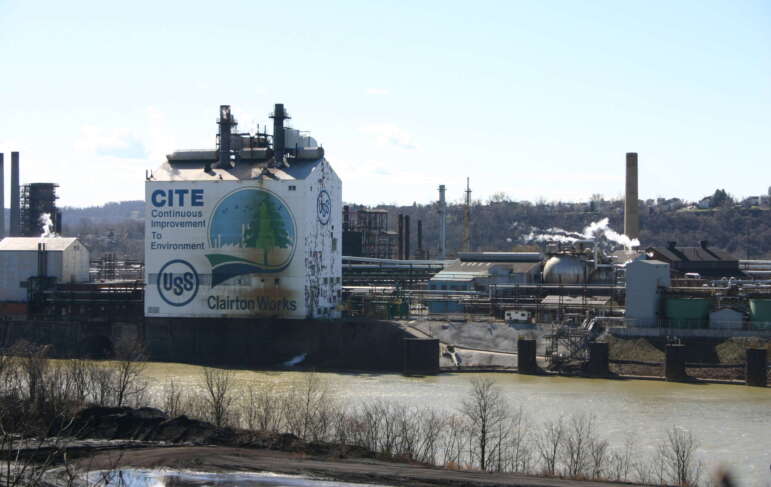
Air Testing Results After Clairton Coke Works Explosion
A little more than a month after a deadly explosion at U.S. Steel’s Clairton Coke Works plant, Allegheny County is sharing the results of its additional air quality testing in the area. Carnegie Mellon University and the Pennsylvania Department of Environmental Protection stationed mobile air units in the Mon Valley days after the explosion to monitor pollution levels. The Department of Environmental Protection and Carnegie Mellon University mobile monitoring and the Allegheny County stationary monitoring found no immediate health risks from the instruments.
The mid-morning explosion on August 11 sent a plume of black smoke into the air and was powerful enough to shake homes in the area. More than 10 workers were injured while two were killed, including one worker whose body was pulled from the rubble after a search that lasted hours. According to U.S. Steel, workers were preparing one of the plant’s batteries for maintenance when a gas-valve failure caused the explosion. The company is cooperating with local and state agencies as well as the United Steelworkers union to investigate the incident.
In part because of the number of industrial sites, the Mon Valley is nationally ranked as a region with poor air quality due to sulfur dioxide pollution and fine particulate levels, according to the nonprofit Clean Water Action. Compared to the other plants in the Mon Valley owned by U.S. Steel–the Irvin plant in West Mifflin and the Edgar Thomson plant in Braddock–the Clairton plant emits the highest levels of pollutants, according to Allegheny County’s emissions inventory. Environmental groups raised concerns after the August explosion and how additional pollution from the blast could impact the health of the surrounding community.
Allegheny County partnered with Carnegie Mellon University and the Pennsylvania Department of Environmental Protection to station mobile air monitors near the fence line of the plant as well as nearby neighborhoods. The mobile health units were able to get closer to the plant compared to the stationary units and tested for a wider range of toxic pollutants. The county reported that the DEP’s monitoring equipment showed short-term exposure limits remained within federal standards set by the Environmental Protection Agency.
DEP chemists did measure concentrations of air toxins including formaldehyde, ethyl benzene, and xylene near the plant, all of which can cause ear, nose, and throat irritation, and worse, can lead to cancer and severe neurological effects from long term exposure. The county cautioned that the concentrations of formaldehyde, ethyl benzene, and xylene were only observed during a brief time period and were mostly undetectable throughout most of the testing periods.
The county acknowledged the findings could indicate health risks, so it said it would continue to evaluate the DEP report and other data to determine if there are other potential issues. Officials said on Friday that preliminary data from CMU’s monitors did not detect any specific toxic hot spots tied to the explosion, though the data has not yet been finalized and remains under review. The additional monitoring took place over two days with crews sampling air at different times of the day to account for any impact weather could have in trapping pollutants near the ground. The county said on Friday that it plans to provide additional information about its monitoring efforts as it becomes available.
Were you exposed to a toxic substance and later diagnosed with mesothelioma, lung cancer, or another cancer? Contact us today to see if you could be entitled to compensation. Call 412-471-3980 or fill out our contact form and a member of our team will get back to you as soon as they can.